
 |
| Sodomites are allowed into St Peter's but not Traditional Catholics |
It didn't work, did it? All that Trad Inc kowtowing to the Novus Ordo-ised, synodal Vatican II version of the One, Holy, Catholic and Apostolic Church is now proven to have been a bad strategy. Wishful thinking. Because now Rome has banned not only the Traditional Latin Mass pilgrims from celebrating Mass in St Peter's, but also from even entering its doors. While sodomites are allowed in, freely.
This Canto Fermo blog isn't specially interested in finger-pointing at Glad Trads or saying "I told you so" but the fact remains that from the first month of Robert Prevost's pretend pontificate his utterances were viewed on this page with suspicion.
And as time has gone on those suspicions, reported here, have only worsened and been confirmed. And the very Catholics who should have known better, on moral and theological grounds, have vilified Canto Fermo for supporting the Society of St Pius X (SSPX) and daring to point out that 'Leo XIV' is a modernist through and through and thoroughly opposed to Catholic truth. This writer was told she was endangering her diocesan Traditional Latin Mass. And much worse things. Such as her eternal destination of hell.
Everyone makes mistakes. But traditional Catholics, of all people, should surely be able to admit they called it wrong and apologise. That's humility, which is the base course of the entire Catholic edifice, and without which all the other virtues collapse. Virtues such as truthfulness. Discernment. Courage. Because how can Catholic commentors see what Prevost/Leo says and does, and fail to report them?
It's okay to be angry about attempted demolition of the Catholic religion. About insults to our Crucified Lord and His Holy Mother and the Eucharist. It's more than okay. It's demanded by our Catholic beliefs and our sanctification and eternal happiness depend on it.
Pope Leo XIII exhorted us in Sapientiae Christinae of January 10, 1890, to defend and proclaim the truth of the Catholic Faith at all times without fail. To safeguard the integrity of the Faith, he insists, is a duty that belongs to each one of the faithful and not just those with power of rule.
Further, one who keeps silence in face of error is repulsive to God and unworthy of eternal salvation. These are important lessons for the progressivist clergy and laymen in our days.https://www.traditioninaction.org/religious/n167_doctrine_2.htm

Roche says Catholics shouldn’t attend the old Mass exclusively. Rome bars traditional pilgrims from St. Peter’s. And the “give Leo a chance” crowd has some explaining to do.
The Pilgrims Who Were Too Catholic for St. Peter’s
Well, well, well. It appears the great experiment in flattering Robert Prevost into restoring Catholic Tradition has encountered a slight difficulty.
The Vatican has reportedly barred the annual Summorum Pontificum pilgrimage from entering St. Peter’s Basilica in procession.
Yes, the same pilgrimage whose organizers spent years emphasizing their loyalty to Rome, their communion with the man they recognize as pope, and their distance from the Society of Saint Pius X.
Apparently, all that impeccable ecclesiastical respectability has purchased them a letter from the Secretariat of State telling them to keep their procession outside.
On October 23, Vatican journalist Diane Montagna reported that Christian Marquant, president of Paix Liturgique and a principal organizer of the pilgrimage, had announced the restriction at Rome’s Augustinianum.
The Vatican’s instruction, as quoted by Marquant, was unmistakable:
“Your procession is not allowed to enter into St. Peter’s Basilica.”
The pilgrims had already been refused permission to celebrate their traditional Mass inside the basilica. Now even their scheduled collective entry to pray at St. Peter’s tomb has reportedly been denied.
These Catholics are being refused entry precisely in their capacity as an organized traditional pilgrimage.
The official program still schedules the pilgrims’ arrival at St. Peter’s on Saturday, October 24, followed by prayers inside the basilica. As of Friday evening, the organizers face the prospect of reaching their destination only to be denied the very collective act of devotion around which their pilgrimage was planned.
Marquant also reported that Leo XIV had allegedly described the previous year’s traditional Mass as having been “instrumentalized” during a December conversation with Bishop Athanasius Schneider.
That characterization comes through Marquant’s account; Leo has not publicly confirmed making the remark. Nevertheless, the reported accusation deserves scrutiny.
Instrumentalized?
In October 2025, Cardinal Raymond Burke celebrated a magnificent traditional pontifical Mass at the Altar of the Chair in St. Peter’s Basilica with Leo’s permission.
Thousands attended. Young Catholics, families, priests, and religious filled the basilica for the Roman liturgy their ancestors had known.
For a moment, the traditionalist media world practically levitated with gratitude.
The new man in white was different. Surely he was different. He wore more traditional vestments. He spoke Latin. He smiled pleasantly. He had permitted Cardinal Burke to celebrate Mass.
Some practically regarded the permission as the first installment on an impending restoration.
One year later, the pilgrims have been refused another Mass in the basilica, and now their organized entrance has been prohibited.
The supposed opening has become a locked door.
Cardinal Roche Explains What the Latin Mass Is Really Allowed to Be

If anyone remains confused about the direction of Leo’s liturgical administration, Cardinal Arthur Roche has thoughtfully removed much of the mystery.
In his October 13 interview with AdVaticanum, the prefect of the Dicastery for Divine Worship declared that Leo would neither reverse Traditionis Custodes nor restore Benedict XVI’s Summorum Pontificum.
Roche was speaking as the principal official responsible for Rome’s liturgical policies. Although his comments were not a new decree issued by Leo, they are hardly the casual speculations of some retired parish priest.
Then came the more revealing statement.
Asked whether Catholics attached to the older liturgy should instead attend the Novus Ordo, Roche replied:
“You should not be going to that Mass exclusively, I think.”
Read that again.
The cardinal did not limit his answer to the SSPX. He was discussing Catholics who attend the traditional Roman Mass generally.
That necessarily raises concerns for Catholics attending diocesan Latin Masses, the Priestly Fraternity of St. Peter, the Institute of Christ the King, and other authorized traditional communities.
To be clear, Roche did not announce a new canonical prohibition on exclusively attending the traditional Mass. His words express his judgment about how Catholics ought to worship.
But that judgment is extraordinary coming from the Vatican’s chief liturgical official.
Consider the practical implications.
A Catholic family attends an authorized traditional Mass every Sunday. Their children receive traditional catechesis, learn Gregorian chant, participate in the old sacramental rites where permitted, and grow up surrounded by Catholic liturgical customs preserved for centuries.
What precisely is wrong with that?
Apparently, exclusive adherence to the older Roman rite is itself becoming an ecclesiastical problem.
The family may attend the Mass, provided the Mass does not become its exclusive spiritual home.
Roche’s language exposes the governing mentality behind the restrictions. The old Mass may be accommodated within the postconciliar system, but Catholics are expected to acknowledge the reformed liturgy as the ordinary norm to which their religious lives must remain attached.
The old rite survives by permission.
The new rite defines the institution.
And now, according to Rome’s liturgical prefect, even exclusively attending an authorized old Mass is something Catholics should reconsider.
One wonders whether the families who have spent years cultivating relationships with diocesan bishops, avoiding controversy, and carefully distinguishing themselves from the SSPX are finally beginning to understand the problem.
Michael Matt’s Great Leo XIV Investment
If anyone remains confused about the direction of Leo’s liturgical administration, Cardinal Arthur Roche has thoughtfully removed much of the mystery.
In his October 13 interview with AdVaticanum, the prefect of the Dicastery for Divine Worship declared that Leo would neither reverse Traditionis Custodes nor restore Benedict XVI’s Summorum Pontificum.
Roche was speaking as the principal official responsible for Rome’s liturgical policies. Although his comments were not a new decree issued by Leo, they are hardly the casual speculations of some retired parish priest.
Then came the more revealing statement.
Asked whether Catholics attached to the older liturgy should instead attend the Novus Ordo, Roche replied:
“You should not be going to that Mass exclusively, I think.”
Read that again.
The cardinal did not limit his answer to the SSPX. He was discussing Catholics who attend the traditional Roman Mass generally.
That necessarily raises concerns for Catholics attending diocesan Latin Masses, the Priestly Fraternity of St. Peter, the Institute of Christ the King, and other authorized traditional communities.
To be clear, Roche did not announce a new canonical prohibition on exclusively attending the traditional Mass. His words express his judgment about how Catholics ought to worship.
But that judgment is extraordinary coming from the Vatican’s chief liturgical official.
Consider the practical implications.
A Catholic family attends an authorized traditional Mass every Sunday. Their children receive traditional catechesis, learn Gregorian chant, participate in the old sacramental rites where permitted, and grow up surrounded by Catholic liturgical customs preserved for centuries.
What precisely is wrong with that?
Apparently, exclusive adherence to the older Roman rite is itself becoming an ecclesiastical problem.
The family may attend the Mass, provided the Mass does not become its exclusive spiritual home.
Roche’s language exposes the governing mentality behind the restrictions. The old Mass may be accommodated within the postconciliar system, but Catholics are expected to acknowledge the reformed liturgy as the ordinary norm to which their religious lives must remain attached.
The old rite survives by permission.
The new rite defines the institution.
And now, according to Rome’s liturgical prefect, even exclusively attending an authorized old Mass is something Catholics should reconsider.
One wonders whether the families who have spent years cultivating relationships with diocesan bishops, avoiding controversy, and carefully distinguishing themselves from the SSPX are finally beginning to understand the problem.
Michael Matt’s Great Leo XIV Investment
I have been criticizing this strategy since Leo’s election.
And for that criticism, I have been subjected to an extraordinary succession of lectures from the self-appointed custodians of traditional Catholic prudence.
The most prominent example is Michael Matt of The Remnant.
When Prevost appeared on the balcony in May 2025, Matt was remarkably eager to discover reasons for optimism.
He relied upon favorable impressions from people supposedly familiar with Prevost. He contrasted the new pontiff’s manner with Francis’s. He discussed the possibility that the responsibilities of the papacy might transform him.
Ten days after the election, Matt announced:
“Our new pope is not Pope Francis II.”
Wonderful.
The theological significance of that declaration was apparently supposed to be self-evident.
The reign of terror was over. The new man might be an honest liberal, perhaps a truth seeker. His traditional vestments, Latin, and more dignified public presentation encouraged speculation about a different future.
I was considerably less impressed.
From the beginning, Leo praised Francis’s legacy, embraced the synodal program, affirmed the direction of Vatican II, and retained the principal architects of Francis’s liturgical and doctrinal regime.
Roche remained at Divine Worship.
Fernández remained at Doctrine.
Traditionis Custodes remained in force.
These were administrative and theological facts, readily available to anyone more interested in the governing record than in the cut of a mozzetta.
Yet critics were repeatedly told that prudence required waiting.
Do not damage the relationship. Do not frighten the new pontiff. Do not antagonize Rome. Give him a chance.
The great strategic objective was apparently to persuade Leo that traditional Catholics were nice people who deserved to keep their Mass.
And how has this magnificent diplomatic investment performed?
Roche says Leo will not restore Summorum Pontificum. Roche discourages exclusive attendance at the old Mass. The Secretariat of State refuses the annual pilgrimage’s traditional Mass at St. Peter’s and reportedly bars its procession from entering.
Matt has since changed his public posture. At the October 2026 Catholic Identity Conference, he and Eric Frankovitch demanded restoration of the traditional Mass and warned that traditionalists would resist further suppression.
Good.
I welcome the stronger language.
But a public demand in October 2026 does not erase the optimistic assurances offered in May 2025.
The correct question is whether the original strategy was based upon sound evidence.
Where was the decree Leo supposedly intended to issue restoring liturgical freedom? Where was the indication that he planned to dismantle Francis’s restrictions? What evidence justified telling traditional Catholics that a fundamentally different pontificate was beginning?
A few ceremonial gestures, favorable anecdotes, and speculation about a change of heart?
That is a rather thin foundation upon which to mortgage the future of Catholic Tradition.
I examined the collapse of that strategy in my earlier article, “Roche Tells Trad Inc. Suckers Leo Isn’t Freeing the Latin Mass.”
Today’s developments provide another installment of the bill.
Rorate Caeli: The Most Exquisite Timing in Traditionalist Journalism
Dr Peter Kwasniewski Then there is Rorate Caeli.
For years, Rorate has performed valuable work documenting restrictions on the traditional Mass. Its archives contain substantial evidence of the postconciliar hierarchy’s hostility toward Catholic liturgical inheritance.
That history makes its intermittent optimism concerning Leo particularly difficult to comprehend.
In August 2025, Rorate praised Leo’s remarks to French altar servers and announced:
“We dodged a bullet.”
A remarkably confident assessment for a pontificate barely three months old.
I challenged that conclusion in my February 2026 examination of the episode.
The deeper problem emerged this month.
On October 12, Rorate published an essay introduced by Professor Peter Kwasniewski criticizing traditionalist pessimism, incessant complaints, and the damage supposedly being done to the movement’s reputation.
The essay, originally published under the pseudonym Eck, argued that traditional Catholics had squandered an extraordinary opportunity by behaving imprudently toward Leo.
The theory was breathtaking.
Traditionalists supposedly possessed enormous political capital following Francis’s death. By complaining too loudly, demanding too much, and criticizing the new pontiff prematurely, they had alienated a potentially sympathetic administration.
I answered the argument in “Rorate’s Kwasniewski Blames the Victim.”
Then came the punchline.
On October 13, just one day after publishing the essay deploring the troublesome naysayers, Rorate reproduced Roche’s interview confirming that Leo would not restore Summorum Pontificum.
Apparently, the naysayers had been reading the situation rather more accurately than the optimists.
To Rorate’s credit, it published the bad news. Indeed, it has also sharply criticized the restrictions.
But that makes the earlier lecture all the more absurd.
How can a publication document the continued repression of the old Mass while suggesting that the principal obstacle to its restoration is the bad manners of those who expose the repression?
Perhaps the next strategic innovation will involve asking Cardinal Roche whether traditional Catholics have been sufficiently cheerful to qualify for admission to St. Peter’s.
Taylor Marshall’s Revolving Door of Papal Prudence
As I documented in “Spin, Taylor, Spin”, Marshall had expressed deep concern about Prevost before the conclave.
After the election, however, his public emphasis shifted toward patience, papal authority, and the need to avoid premature conclusions.
Then came the SSPX consecrations, and Marshall became considerably more exercised about episcopal disobedience than about the broader crisis the Society claimed justified its actions.
By the summer, he was acknowledging Roche’s opposition to restoring Summorum Pontificum while continuing to emphasize mitigating explanations for Leo’s approach.
Perhaps Leo had been formed entirely within the Novus Ordo. Perhaps his missionary background explained his attitude. Perhaps he simply lacked a sufficiently developed appreciation of liturgical questions.
What an extraordinary privilege.
When Francis restricted the Mass, commentators knew precisely what the policy signified.
When Leo maintained the restrictions, the same facts required an elaborate biographical explanation.
The Church’s liturgical future was supposedly being determined by a man who might merely need another year or two to discover that the old Mass was worth defending.
One would hope that the education of the alleged supreme legislator could proceed before the ancient Roman rite disappeared from another generation of parish churches.
Flanders, Sammons, and the Spirituality of Managed Defeat

Timothy Flanders and Eric Sammons offered another variation of the strategy during their September discussion on Crisis Point.
I examined their arguments in “The New Trad Strategy: Trust Leo, Obey the Bishop, and Learn to Love the Novus Ordo.”
Their discussion concerned the SSPX, obedience, legitimate authority, and how traditionalists ought to respond to liturgical difficulties.
Flanders urged Catholics to maintain a pious disposition toward Leo and extend him the greatest reasonable benefit of the doubt.
Sammons likewise stressed obedience, ecclesial communion, and the spiritual dangers of treating the reformed liturgy as intrinsically harmful.
Prayer, humility, charity, and obedience are genuine Catholic virtues. The problem begins when appeals to those virtues become substitutes for answering the underlying theological and historical questions.
Why should Catholic families regard exclusive attachment to the traditional Roman rite as suspect?
Why does the old Mass require special restrictions after centuries of forming Catholic saints?
And why should objections to this arrangement be treated primarily as failures of ecclesiastical disposition?
Roche has now supplied the essential premise of the postconciliar position.
Catholics should not attend the old Mass exclusively.
Perhaps Flanders and Sammons might explain why the Vatican’s chief liturgical official is entitled to question a family’s exclusive attendance at an authorized traditional Mass while traditionalists are expected to exercise almost unlimited restraint in questioning him.
The Other Experts Who Advised Patience


The wider circle of traditionalist and conservative commentators has displayed different forms of the same weakness.
Anthony Abbate of Avoiding Babylon explicitly said in an April discussion that he did not wish to join those attacking Leo. His comparatively gentle approach to Rome contrasted sharply with the forcefulness of his criticism of other political and ecclesiastical figures.
Mark Lambert and Matt Gaspers joined Katherine Bennett in an April Catholic Unscripted conversation responding to my work and warning against what they regarded as excessive anger, bitterness, and factionalism.
As I documented in “Gaspers & Catholic Unscripted: ‘Thank God’ Catholics Don’t Know What’s Going on in Rome,”, the discussion included an extraordinary moment when the participants acknowledged that ordinary Catholics knew relatively little about Vatican controversies.
Lambert responded with an amused “Thank God!”
I found that sentiment appalling then. I find it even less defensible now.
The faithful have a right to understand the decisions affecting their worship, their priests, and their families.
Kennedy Hall, meanwhile, defended a more charitable interpretation of Leo’s earlier controversial religious gestures, including material concerning Prevost’s participation in a 1995 Indigenous ceremony.
I criticized that approach in “Leo Kneels and Prostrates Himself Before Pachamama in 1995.”
Hall’s argument emphasized the postconciliar precedents established by John Paul II. But invoking those precedents arguably illustrates the continuity of the very ecclesiastical problem traditionalists have spent decades criticizing.
Damian Thompson has also repeatedly urged caution before drawing sweeping conclusions about Leo, although he has criticized particular decisions and scandals. Gavin Ashenden has offered his own analyses of the emerging pontificate.
I will not pretend that every commentator held precisely the same position, uttered the same assurances, or supported every policy adopted by Rome. But their varying degrees of optimism, caution, or reluctance to draw severe conclusions now deserve reassessment against the actual record.
A commentator who urged patience has an obligation to explain what that patience was expected to accomplish.
A commentator who praised the new pontiff’s demeanor should explain why demeanor was treated as evidence of doctrinal or liturgical reform.
And commentators who chastised those raising early objections should revisit whether their own confidence was justified.
Some of these men have already begun criticizing Leo more directly. That is welcome.
But a change in tone should be accompanied by an honest reckoning with the original analysis.
The Diocesan Trads Were Supposed to Be Safe
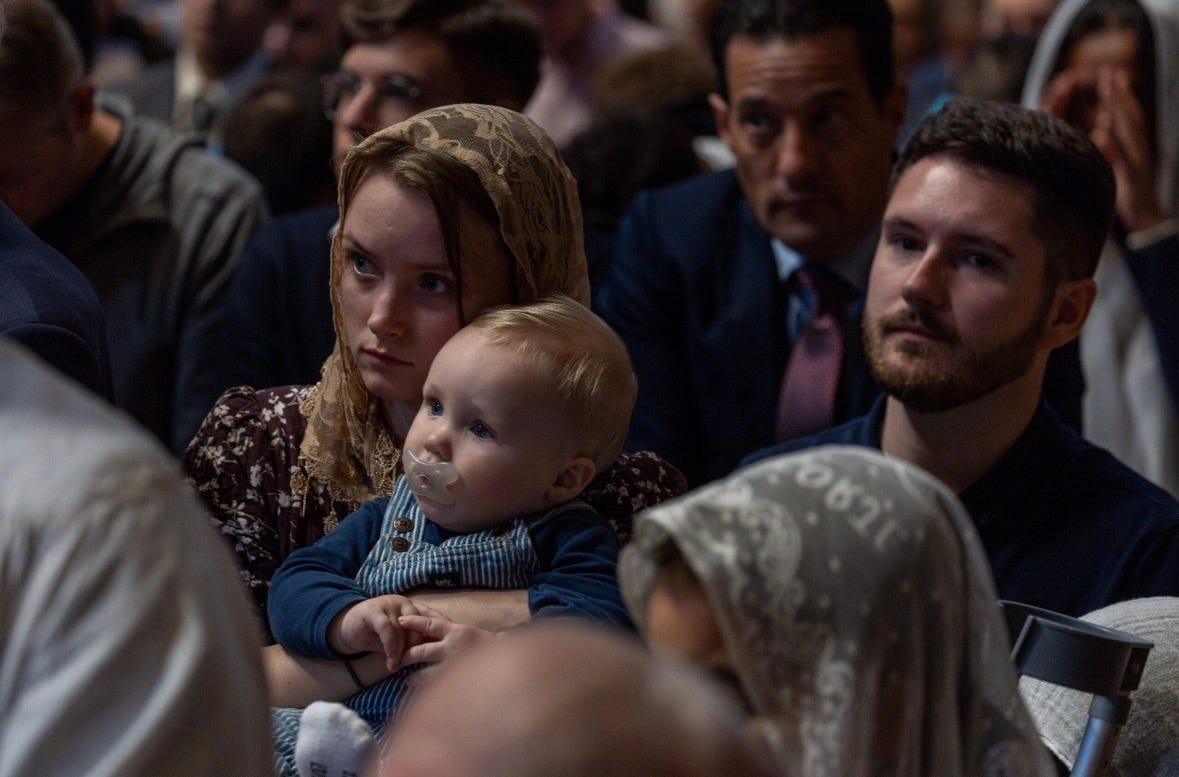
There is another dimension to the present controversy that should trouble Catholics who have carefully avoided association with independent traditionalist communities.
The Summorum Pontificum pilgrimage is emphatically identified with Catholics who recognize the Roman authorities and seek permission to celebrate the old rite.
Its organizers repeatedly emphasize their ecclesiastical loyalty.
They have sought accommodation rather than confrontation.
They have approached the Vatican through its established channels.
They have stressed that they are cum Petro et sub Petro.
And now they have been refused permission to hold their traditional Mass in St. Peter’s and reportedly denied organized entry to the basilica.
What exactly remains of the theory that traditional Catholics can guarantee their future by demonstrating sufficient obedience and maintaining sufficiently cordial relationships?
Roche’s statement about exclusive attendance makes the question even more serious.
The SSPX has always represented the most obvious disciplinary target because of its unauthorized episcopal consecrations and disputed canonical status.
But a family attending an approved FSSP chapel has not consecrated any bishops.
A mother bringing her children to an Institute of Christ the King apostolate is not establishing an alternative hierarchy.
A diocesan Catholic attending the traditional Mass every Sunday is not thereby repudiating communion with the Church.
Yet Roche’s objection to exclusive attendance makes no distinction among them.
His criticism concerns their attachment to the older liturgy itself.
There is the real revelation.
The issue is ultimately broader than whether traditional Catholics accept Rome’s preferred canonical arrangements.
The postconciliar authorities evidently want Catholics to regard the reformed liturgy as normative and the older rite as a permitted exception whose very exclusivity requires correction.
That is a theological and ecclesiastical demand extending far beyond the Society of Saint Pius X.
The obedient diocesan traditionalist who believed his family’s liturgical future was secure because he avoided the SSPX should pay particular attention.
A Year of Good Manners Has Produced No Restoration
He did authorize Cardinal Burke’s Mass in October 2025.
He has sometimes employed more traditional ceremonial forms than Francis.
Some Catholics undoubtedly found his manner more dignified and reassuring.
But governing a Church involves considerably more than producing an attractive photograph or granting a ceremonial concession.
The question is whether Leo has altered the juridical and theological framework responsible for restricting the traditional Roman rite.
He has not restored Summorum Pontificum.
Traditionis Custodes remains operative.
The Vatican’s chief liturgical official explicitly discourages exclusive attendance at the old Mass.
The 2026 Summorum Pontificum pilgrimage faces restrictions greater than those imposed upon its 2025 celebration.
And the SSPX remains engaged in a grave canonical dispute with Rome following its July episcopal consecrations.
The evidence establishes continuity of policy far more clearly than the promised restoration.
Perhaps Leo will eventually change direction. No human commentator possesses advance knowledge of every future decision.
But the possibility of a hypothetical future restoration cannot indefinitely excuse the realities of the present.
Nor should criticism of those realities be blamed for the authorities’ decision to maintain them.
If Leo wished to restore broad freedom to the traditional Mass, a few angry Substack articles would present a rather feeble obstacle.
And if he would withhold that freedom because Catholic writers failed to flatter him sufficiently, that would reflect badly upon his exercise of authority, rather than upon Catholics who asked inconvenient questions.
Hiraeth Warned You. Trad Inc. Told You to Wait.

I am perfectly willing to acknowledge mistakes when the evidence demands it.
If Leo restores the traditional Mass, I will report it.
If he reverses a destructive policy, I will welcome the reversal.
If a traditionalist writer accurately identifies a genuine improvement, I will give him credit.
But I will not apologize for examining Leo’s actual record while other commentators preferred to speculate about his future benevolence.
The central prediction made repeatedly at Hiraeth in Exile was straightforward: Leo’s praise of Francis, commitment to Vatican II, preservation of the synodal apparatus, and retention of officials such as Roche indicated that the fundamental direction of the previous pontificate would continue.
Nothing reported this week undermines that assessment.
Quite the contrary.
Roche has told traditional Catholics what he believes Leo intends.
The Secretariat of State has told the Summorum Pontificum pilgrims what their organized procession may do.
And the defenders of endless patience are left explaining why the expected restoration remains invisible.
This is the danger of turning political access into a substitute for Catholic judgment.
Eventually, the strategy designed to protect the Mass becomes a reason to discourage the very criticism that might expose its continued suppression.
Catholics deserve better than another year of soothing speculation about Robert Prevost’s temperament.
They deserve clear reporting, serious theological analysis, and a willingness to examine the Roman authorities according to the Church’s inherited faith.
That has been my purpose at Hiraeth in Exile, even when the self-appointed adults of Trad Inc. considered the work insufficiently diplomatic.
The latest developments offer them an opportunity for genuine reflection.
Perhaps next time they will examine the policies before celebrating the vestments.
And perhaps traditional Catholics will remember this episode when the next supposedly sympathetic Roman official arrives offering reassuring words, a few photographs, and another invitation to be patient.
The pilgrims were told to remain loyal.
They remained loyal.
They were told to seek permission.
They sought permission.
They were told to remain in communion with Rome.
They proclaimed that communion.
Now their procession has been told it cannot enter St. Peter’s.
So much for the great strategy of winning the hierarchy’s heart.
The ancient Roman Mass is still restricted. Its defenders are still expected to be grateful for permission to possess what their ancestors received as an inheritance.
And the great Leo XIV gamble has produced another lesson in the dangers of mistaking hope for evidence.
Next time, perhaps the experts should read Hiraeth before telling everyone else to be quiet.
After all, tomorrow’s ecclesiastical disappointments have an unfortunate habit of appearing here first.https://bigmodernism.substack.com/p/rome-bars-latin-mass-pilgrims-from

 |
| Christ and the Tribute Money Peter Paul Rubens |

