To comment please open your gmail account or use my email address, FB Messenger or X.
 |
It's staring us in the face, folks. Globalism is the new Communism and the supposedly right-wing Luxon-led Coalition Government of New Zealand is shaping up nicely as its suitably conformist, submissive Ardern-trained fellow-travellers.
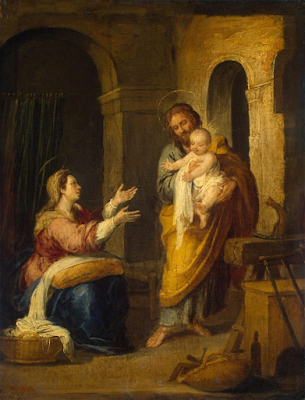
We've just passed May Day, which began as International Workers' Day in 1886 when 300,000 American workers walked off the job in protest at long working hours and capitalism. May Day was glorified by the Soviet Union as exaltation of communism and its military might. In 1955 Pope Pius XII made May Day the feast of St Joseph the Workman, so that the Christian understanding of work would not be lost. But in pagan New Zealand, after generations of socialist indoctrination in education and the mainstream media, and appalling apathy in NZ's Catholic Bishops, lost it certainly is.
Not only the value of work is lost, but equality before the law and property rights are now threatened. Separatism is surging and parliamentary sovereignty is at risk. It's the stuff of revolutions - which were ever the tool for overturning democracies like New Zealand's and converting countries to communism. Only now it's not just countries, it's the whole globe.

New Zealanders who long to see our country recover from the Labour Government’s devastation (2017-2023) and once again become a beacon of innovation and achievement have been heartened by National’s current goals: getting the books back in the black, restoring international relations, and refocusing education so that children learn to read, write and do arithmetic.
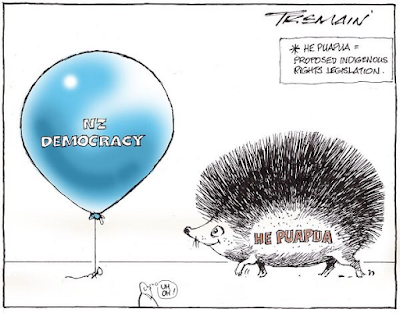
Unfortunately, some recent developments suggest a continuing of Labour’s anti-democratic agenda, as epitomised by the He Puapua manifesto. And the previous National Government is not innocent either.
While dyed-in-the-wool blue supporters may not want to admit it, many separatist, anti-democratic policies were put in place by former Prime Minister John Key and his Attorney-General Chris Finlayson— “a very clever lawyer”.
Among the most glaring examples of apartheid policies from their nine-year tenure were:
Entering into coalition with the separatist Māori Party, despite not needing to.
Imposing the Independent Māori Statutory Board (IMSB) on Aucklanders as part of the 2009 Super City structure—an unaccountable tribal entity that is a significant financial burden on ratepayers and a huge influence on Council operations.
Removing Crown ownership of the entire coastline and territorial seabed, making it available for Māori tribal and hapu claims—at immense taxpayer expense.
 |
Allowing the Māori Party co-leader to secretly sign New Zealand up to the UN Declaration on the Rights of Indigenous Peoples (UNDRIP) —a move that even Labour Prime Minister Helen Clark had rejected as inappropriate for New Zealand.
Embedding the concept of co-governance into Treaty settlements, resulting in damaging or costly race-based governance structures such as the 2014 Tūpuna Maunga Authority (TMA), the 2014 Te Urewera Act, and the 2010 Waikato River Settlement Act.
Securing Finlayson’s future career as a tribal litigator taking advantage of the loose legislation he enacted while in Parliament.
Since Labour’s ousting in 2023, the National-led coalition government has been fronted by a John Key protégé—Chris Luxon—and includes another “very clever lawyer,” Minister Tama Potaka, a former Māori Party member parachuted into the National Party via the 2022 Hamilton West by-election and quickly elevated to Cabinet.
 |
It was deeply concerning that Prime Minister Luxon said he didn’t like anything about the Principles of the Treaty of Waitangi Bill 2025—a bill designed to secure parliamentary sovereignty, citizen equality, and property rights. Even more alarming, he ruled out allowing New Zealanders to vote on these critical constitutional matters.
 |
Adding to the disquiet is National’s continued separatist trajectory—seemingly driven by Minister Potaka, whose key portfolios include Māori Development, Whānau Ora, Conservation, and Māori Crown Relations: Te Arawhiti. National’s and Minister Potaka’s recent record includes:
Failing to stop activist judges from misapplying the 2011 Marine and Coastal Area Act.
Failing to halt Ngāi Tahu’s legal claim for control over South Island freshwater.
Supporting the Department of Conservation’s plans for ‘Modernising Conservation Land Management’, which prioritise race-based entitlements, ideologies and business opportunities—embedding discrimination and division by way of new legislation.
Endorsing Te Kawerau ā Maki’s draft Deed of Acknowledgement, which would give the tribe co-governance rights—potentially even a majority—over the extensive Waitākere Ranges Heritage Area, encompassing public land, resources, and the coast. A similar deal with Ngāti Whātua for the rest of Auckland is already in the pipeline.
- Failing to stop the systemic imposition of Māoritanga, tikanga (variable and often contested Māori customs and values), and the dramatically expanded Māori language—across education (including for foreign students), the public service, and civic life.
- Supporting the creation of a new parliamentary committee, led by Labour’s Adrian Rurawhe, to formally integrate tikanga Māori into parliamentary procedure.
 |
Yet should we be surprised? Potaka may avoid scrutiny and deflect responsibility for his actions, but his intentions have been clear for years.
He has stated that National would be even more committed to “working alongside Māori”—but in ways that avoid “a centralised bureaucracy.” Regarding Māori–Crown relations, he supports state devolution, more “partnerships,” and believes Māori are entitled to “self-determination.” (Stuff, 12/4/23)
 |
| Te Pati Maori co-leader, Rawiri Waititi |
During his time at Victoria University, Potaka also authored a radical, apartheid-style paper declaring:
"More important... is the... greater control and power over resources for Māori… That action means a Treaty-driven legislative agendum focused on requiring local government authorities to comply with the Treaty in all their activities... Central government and local government need to consider sharing power with Māori, instead of hoping that Māori entitlements and demands will be satisfied with policies that effectively mainstream Māori into Pākehā society. Anything less than an increase in power for Māori would signal yet another failure in respecting the Treaty.” — ((1999) 29 VUWLR)
Constitutional Overthrow
The National Party’s actions speak far louder than its election slogans. New Zealanders must focus on those actions and hold the Party and the Coalition Government to account right now and at the 2026 election—if we want to live in a first world country.
Under MMP, we must cast our votes only for parties that can produce real evidence of a commitment to Western democratic values—not the creeping tribal autocracy now suffocating public life and institutions.
And in the meantime, we have the Local Body elections coming up in October this year. Remember, anarchists never sleep, and Minister Potaka has made his anti-democratic intentions for local government very clear. https://www.bassettbrashandhide.com/post/fiona-mackenzie-is-national-the-red-under-the-bed?utm_campaign=4f8f6b8d-65db-4
 |
| The Good Shepherd Bartolomé Esteban Murillo |
"But the hireling, and he that is not the shepherd, whose own the sheep are not, seeth the wolf coming and leaveth the sheep and flieth: and the wolf catcheth and scattereth the sheep"